
The Blade That Cuts Hair But Can't Cut Skin
A 50-year-old surgical technology, adapted for grooming. Here's the mechanism — and why it's safe on the most sensitive skin on the body.
Reviewed for Technical Accuracy
The oscillating cutting principle has been used in clinical settings for decades — most familiarly in the cast saws used to remove orthopedic casts.

A standard razor edge under magnification. Every pass abrades the skin surface, not just the hair.
Every standard blade works by slicing
A razor, a rotary trimmer, a foil shaver — they all cut the same way. A sharp edge drags across the skin and slices whatever it contacts. Hair, yes — but skin too. This is the mechanical source of nicks, micro-cuts, and the irritation that follows a close shave.

Orthopedic cast removal: the saw cuts rigid plaster while resting against the patient's skin — without breaking it.
Surgeons solved this 50 years ago
To remove a hard cast from a healed limb, clinicians needed a blade that could cut through solid plaster while held directly against the patient's skin — and never break it. The solution, the oscillating cast saw, has been standard equipment in orthopedic settings for decades.

The key: it doesn't spin
A cast saw blade does not rotate. It oscillates — vibrating side to side roughly one millimeter, thousands of times per minute. That small, extremely fast back-and-forth is the entire principle. It is not a smaller razor; it is a fundamentally different cutting action.

Rigid is cut. Soft moves with it
Hard materials — plaster, hair — cannot flex quickly enough to follow the oscillation, so the blade cuts them cleanly. Soft, elastic materials — skin — simply move along with the vibration. The blade cannot grab what bends with it. The safety is not an added feature; it is a property of the motion itself.
See the Application →
Below-the-belt skin is thinner, looser, and more sensitive — the region where slicing blades carry the highest risk.
Why it matters most below the belt
The skin in the groin and lower abdomen is the loosest, thinnest, and most sensitive on the body — the highest-risk region for a slicing blade, and the ideal use case for one that physically cannot cut soft tissue.
View the Trimmer →The core principle: rigid material is cut, soft tissue is not. The safety is not a setting that can fail or a guard that can slip — it is a property of how the blade moves.
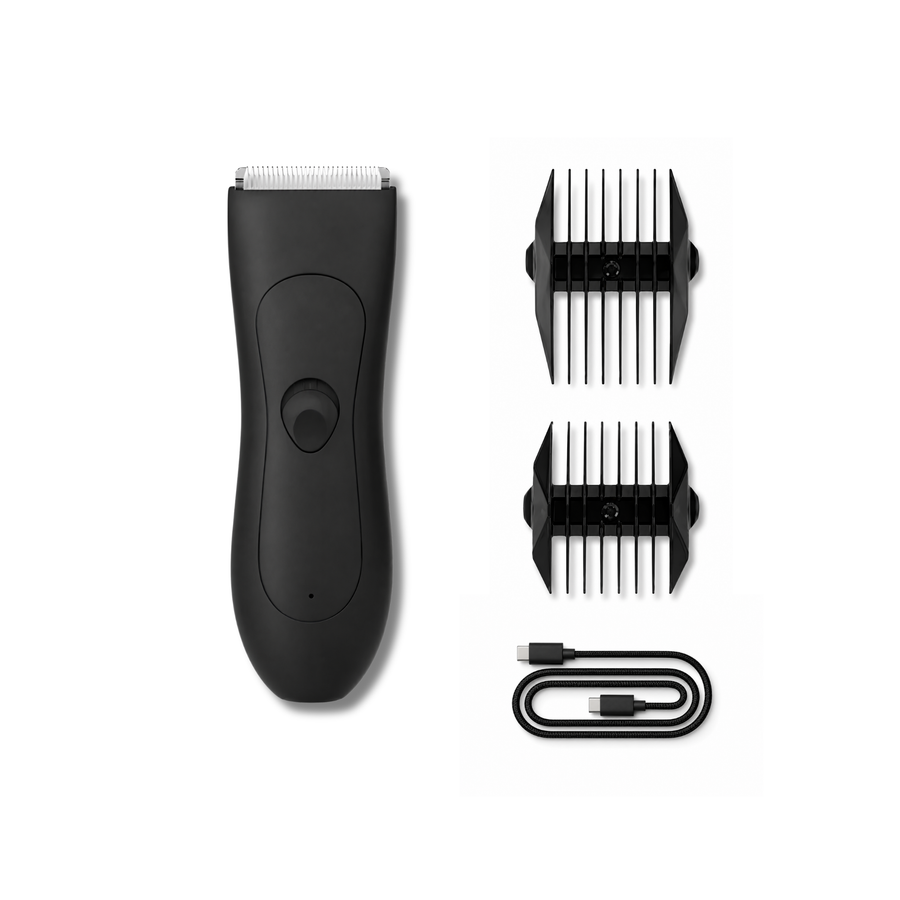
The Precision Trimmer 2.0
- Oscillating Blade Technology
- Trims in one pass
- No-Cut Guarantee
Cuts hair. Not you.
The cutting principle clinicians have trusted to work millimeters from skin — adapted for the one place where a slip matters most.
Check Availability →Disclosure: This page is informational and describes the general mechanism of oscillating-blade technology. The ManMade Precision Trimmer 2.0 is a personal grooming device for external use only and is not a medical device. Individual results may vary.